
Gifts for the Kings: The Akhal-Teke in Royal History
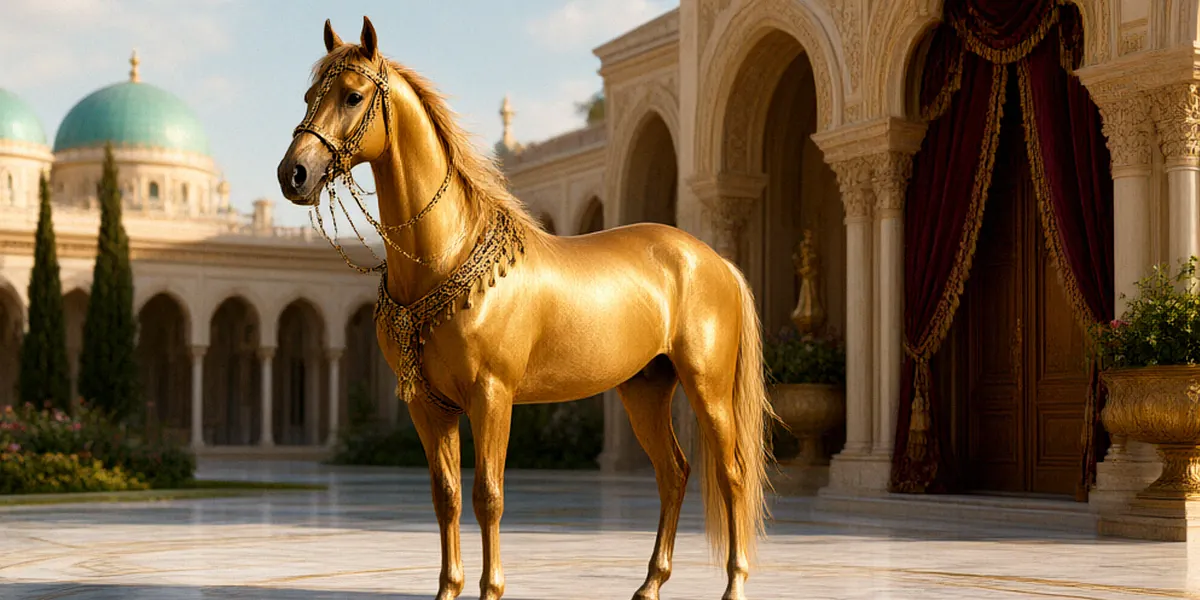
Picture a stallion standing alone in a courtyard, his coat catching the light until it seems to burn with a metallic gold sheen. This is the Akhal-Teke horse, and for centuries he was led not into battle but into throne rooms, presented as a gift between rulers who understood exactly what such an animal represented. From the courts of Persia to the palaces of St Petersburg and London, the golden horse carried with him the weight of alliances, the promise of friendship, and the prestige of empires. So why did this slender, desert-bred horse captivate monarchs from Persia to Britain? We think the answer lies in a combination of beauty, endurance, and the sheer rarity that made him a treasure fit for kings.
The Golden Horse of Royal Courts
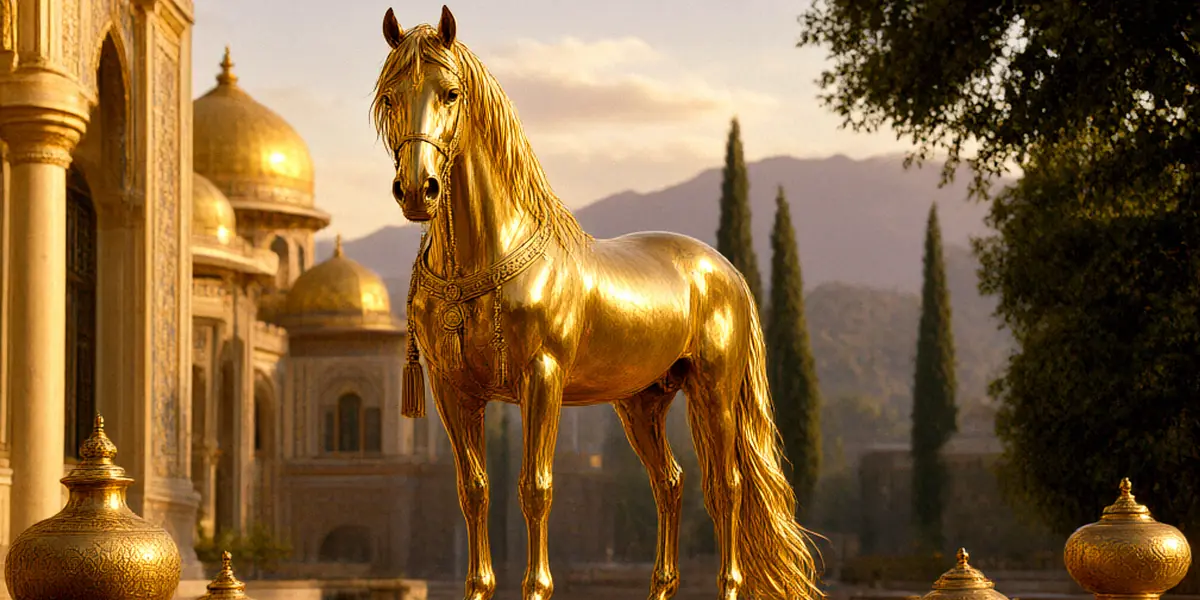
Long before the breed had a formal name, the ancestors of the Akhal-Teke horse were prized possessions in the royal courts of Central Asia and the Middle East. These were not working animals in the ordinary sense. They were status symbols, parade horses, and living proof of a ruler’s access to the finest bloodlines in the known world. To own one was to signal wealth, taste, and connections that reached across deserts and mountain passes.
The breed’s role as a gift between monarchs is well documented across Persia, the Ottoman Empire, and later Russia. A horse given from one ruler to another was never simply transport. It was a diplomatic statement, a gesture that said more than any letter could. The golden coat, in particular, set the Akhal-Teke apart from almost every other breed, making it instantly recognisable and impossible to mistake for anything ordinary.
Ancient Persian and Parthian Origins
The roots of the Akhal-Teke horse reach back to the Parthian and Persian civilisations, where desert-bred horses with remarkable stamina were celebrated in art, poetry, and royal records. These horses were bred in the arid regions south of the Caspian Sea, in what is now Turkmenistan, where survival demanded efficiency, toughness, and a coat that could reflect the harsh sun rather than absorb it. Persian rulers valued them highly, and they passed between royal households as marks of favour and alliance.
The Golden Coat as a Symbol of Divinity
The famous metallic sheen of the Akhal-Teke is not a myth or an exaggeration. It is linked to the dun gene, which produces the pale golden body colour and darker points that give the breed its characteristic glow. In ancient cultures, gold was associated with the sun, with divinity, and with royal power. A horse that appeared to be made of gold therefore carried symbolic weight far beyond its practical value. We often hear the breed described as the golden horse, and in a royal context that name was never just poetic.
Akhal-Teke Gifts to European Monarchs
As trade routes and diplomatic channels expanded, the Akhal-Teke horse began to appear in European courts. Russian expansion into Central Asia brought the breed firmly into the orbit of the imperial court, and from there these horses travelled further west as gifts of extraordinary value. European monarchs who had never seen a horse quite like the Akhal-Teke were quick to recognise its uniqueness.
Russian Tsars and the Imperial Stud
Russian Tsars maintained an imperial stud of Akhal-Teke horses, and the breed became closely associated with the Romanov court. The stud at Tsarskoye Selo and later at other imperial estates served both as a breeding operation and as a showcase of the empire’s reach into exotic territories. Horses from this stud were used in ceremonial parades and presented to visiting dignitaries, reinforcing the connection between the breed and imperial prestige.
Queen Victoria and the British Connection
The British connection to the breed owes much to this tradition of royal gifting. Queen Victoria received an Akhal-Teke horse as a gift in the 19th century, a presentation that introduced the golden horse to the British aristocracy in a very direct way. This was not a casual acquisition. It was a diplomatic gesture from the Russian court, and it placed the Akhal-Teke firmly within the sphere of British royal interest. The horse’s arrival sparked curiosity among breeders and horsemen who had never encountered a breed with such a distinctive coat and conformation.
The Akhal-Teke Stallion as a Diplomatic Treasure
Of all the horses used as diplomatic gifts, it is the Akhal-Teke stallion that carries the greatest symbolic weight. A stallion represents the future of a bloodline. Giving one away was a significant act, and receiving one was an honour that few could match. Throughout the 19th and 20th centuries, stallions moved between courts and private breeders as instruments of diplomacy, and their influence on breeding programmes was often profound.
Boi-Noukar: The Stallion That Shaped Breeding
Among the most famous examples is Boi-Noukar, an Akhal-Teke stallion gifted to a British breeder. His arrival in the United Kingdom was a turning point for the breed in this country, and his bloodline can be traced through many subsequent generations. Boi-Noukar demonstrated exactly why the Akhal-Teke stallion was such a valuable gift. He was not merely a beautiful animal. He was a foundation sire, capable of passing on the breed’s distinctive qualities to his offspring and shaping the direction of British Akhal-Teke breeding for decades.
Diplomatic Gifts in the 20th Century
The tradition of gifting Akhal-Teke horses continued into the 20th century, though the political landscape changed dramatically. Soviet leaders occasionally presented the breed to foreign dignitaries, and the association between the Akhal-Teke and high-level diplomacy remained intact. In 1956, Nikita Khrushchev famously presented an Akhal-Teke stallion to Queen Elizabeth II, a gift that echoed the earlier presentation to Queen Victoria and reinforced the breed’s place in the story of Anglo-Russian relations.
Akhal-Teke Breeding and Royal Legacies in the UK
The royal gifts of the 19th and 20th centuries did more than flatter their recipients. They planted the seeds of British Akhal-Teke breeding, and those seeds have grown into a small but dedicated community of owners and breeders across the United Kingdom. We owe a great deal to those early importations, and to the breeders who saw something worth preserving in this remarkable desert breed.
Early UK Importations and Breeders
The arrival of Boi-Noukar and other early imports gave British breeders access to genuine Akhal-Teke bloodlines at a time when the breed was almost unknown outside Russia and Turkmenistan. These pioneers faced significant challenges. The breed was rare, information was scarce, and the costs of importation were considerable. Yet they persisted, and their efforts laid the groundwork for everything that followed.
Modern UK Breeders and the Golden Horse Legacy
Today, the Akhal-Teke Society of Great Britain, founded in 1991, serves as the focal point for breed enthusiasts in this country. The society maintains records, supports breeders, and promotes awareness of the breed among the wider equestrian public. Modern UK breeders continue to work with the bloodlines established by those early imports, and the golden horse retains a loyal following among those who appreciate its unique combination of speed, endurance, and striking appearance.
The Akhal-Teke Foal: A Modern Royal Gift?
Does the tradition of gifting Akhal-Teke horses continue today? In some respects, yes. The Akhal-Teke foal remains a symbol of prestige and future promise, and there are contemporary examples of foals being presented to dignitaries or royalty. The gesture carries the same weight it always did, even if the political context has changed.
Contemporary Gifting of Akhal-Teke Foals
In recent decades, Akhal-Teke foals and young horses have been presented as gifts between heads of state, particularly within Central Asia and between Turkmenistan and other nations. These gifts maintain the ancient tradition of using the breed as a diplomatic instrument, and they ensure that the golden horse remains associated with the highest levels of international relations.
The Foal as a Symbol of Future Promise
A foal represents potential. It is a gift that will grow, develop, and perhaps produce future generations. When a ruler or dignitary receives an Akhal-Teke foal, they are being entrusted with a living piece of the breed’s future. We find this symbolism particularly fitting, because the Akhal-Teke has always been a breed defined by its bloodlines and its ability to pass on its unique characteristics.
- The Akhal-Teke horse was prized in ancient Persia and Parthia for its stamina and golden coat.
- Russian Tsars maintained an imperial stud of Akhal-Teke horses.
- Queen Victoria received an Akhal-Teke horse as a gift in the 19th century.
- Boi-Noukar was a famous Akhal-Teke stallion gifted to a British breeder.
- The Akhal-Teke Society of Great Britain was founded in 1991.
- The golden coat of the Akhal-Teke is linked to the dun gene.
The legacy of the Akhal-Teke as a gift for kings endures in the breeding programmes, societies, and individual enthusiasts who keep the breed alive in the United Kingdom today. Every foal born to a British breeder carries a thread of that royal history, and every owner who appreciates the golden horse participates in a tradition that stretches back thousands of years. We are proud to play our part in that story, and we hope this resource helps more people discover why the Akhal-Teke has always been a horse fit for royalty.
FAQ
Why is the Akhal-Teke called the golden horse?
The Akhal-Teke is often called the golden horse because of its distinctive metallic coat, which is linked to the dun gene. This gene produces a pale golden body colour with darker points, giving the coat a shimmering, almost luminous quality that is unique among horse breeds.
Did Queen Victoria really own an Akhal-Teke?
Yes. Queen Victoria received an Akhal-Teke horse as a gift in the 19th century. The presentation was a diplomatic gesture from the Russian court and helped introduce the breed to British aristocracy and breeders.
Who was Boi-Noukar?
Boi-Noukar was a famous Akhal-Teke stallion gifted to a British breeder. He became an important foundation sire for the breed in the United Kingdom, and his bloodline influenced many subsequent generations of British-bred Akhal-Teke horses.
When was the Akhal-Teke Society of Great Britain founded?
The Akhal-Teke Society of Great Britain was founded in 1991. It serves as the primary organisation for breed enthusiasts in the UK, maintaining records and supporting breeders and owners.
Are Akhal-Teke foals still given as gifts today?
Yes, the tradition continues in some contexts. Akhal-Teke foals and young horses have been presented as gifts between heads of state, particularly within Central Asia, maintaining the ancient association between the breed and diplomacy.